PERMANENT DATA PRESERVATION
Permanent Data Preservation for Multi-Generational Trusts
A continuity layer designed to preserve the legal, personal and asset history of long-term trust clients across generations, institutions and centuries.
THE LONG-TERM TRUST PROBLEM
A 1,000-Year Promise Should Not Depend on One Institution
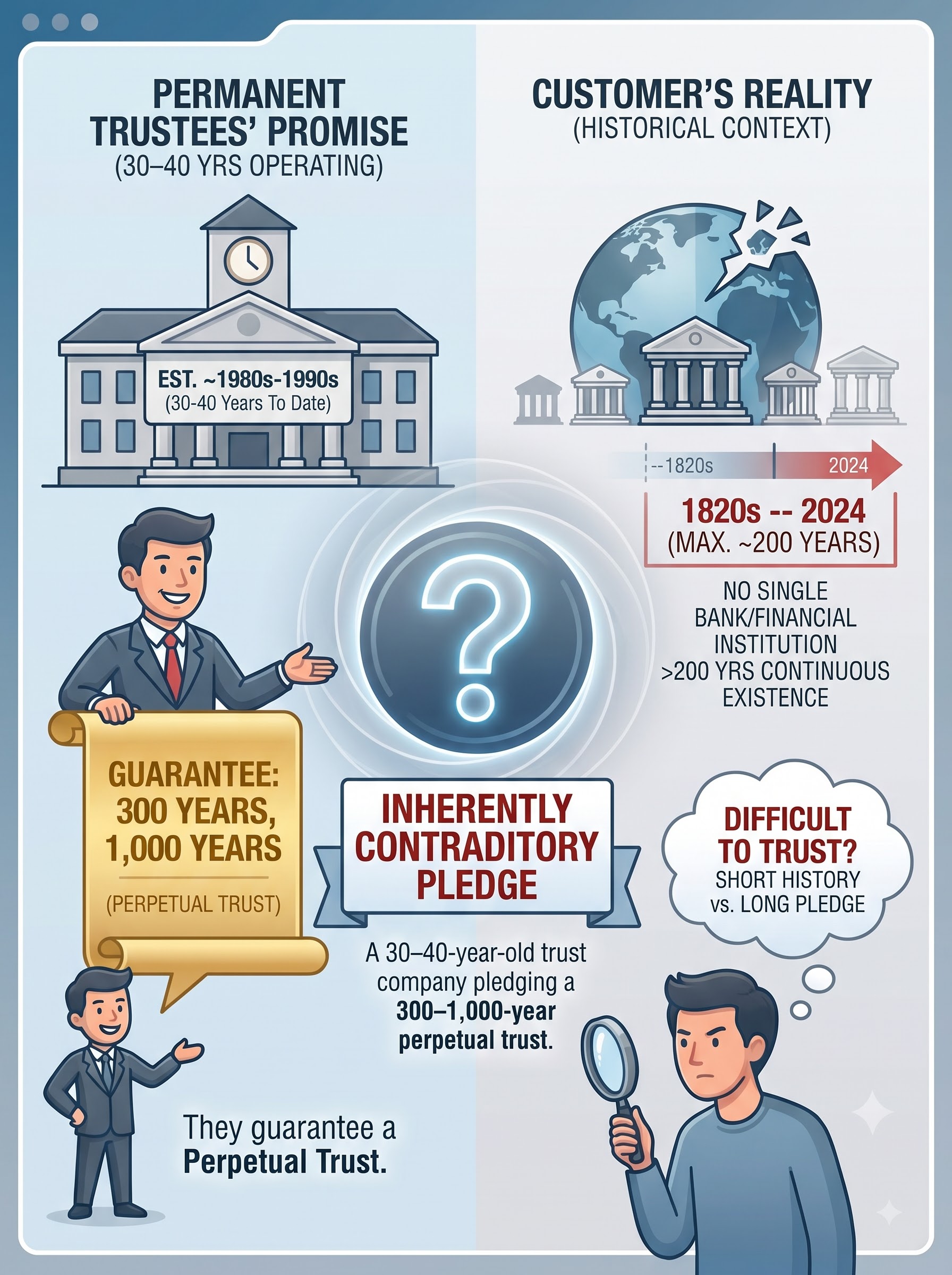
A perpetual trust may be designed to continue for hundreds of years. But the financial institution administering it today may change many times during that period.
Banks and trust companies may merge, be acquired, change ownership, restructure, migrate data systems, change their corporate names or operate under entirely different regulatory frameworks.
Over a 300- or 1,000-year horizon, institutional continuity and data continuity are not necessarily the same thing.
A HYPOTHETICAL 174-YEAR JOURNEY
What Could Happen to Thomas’ Trust?
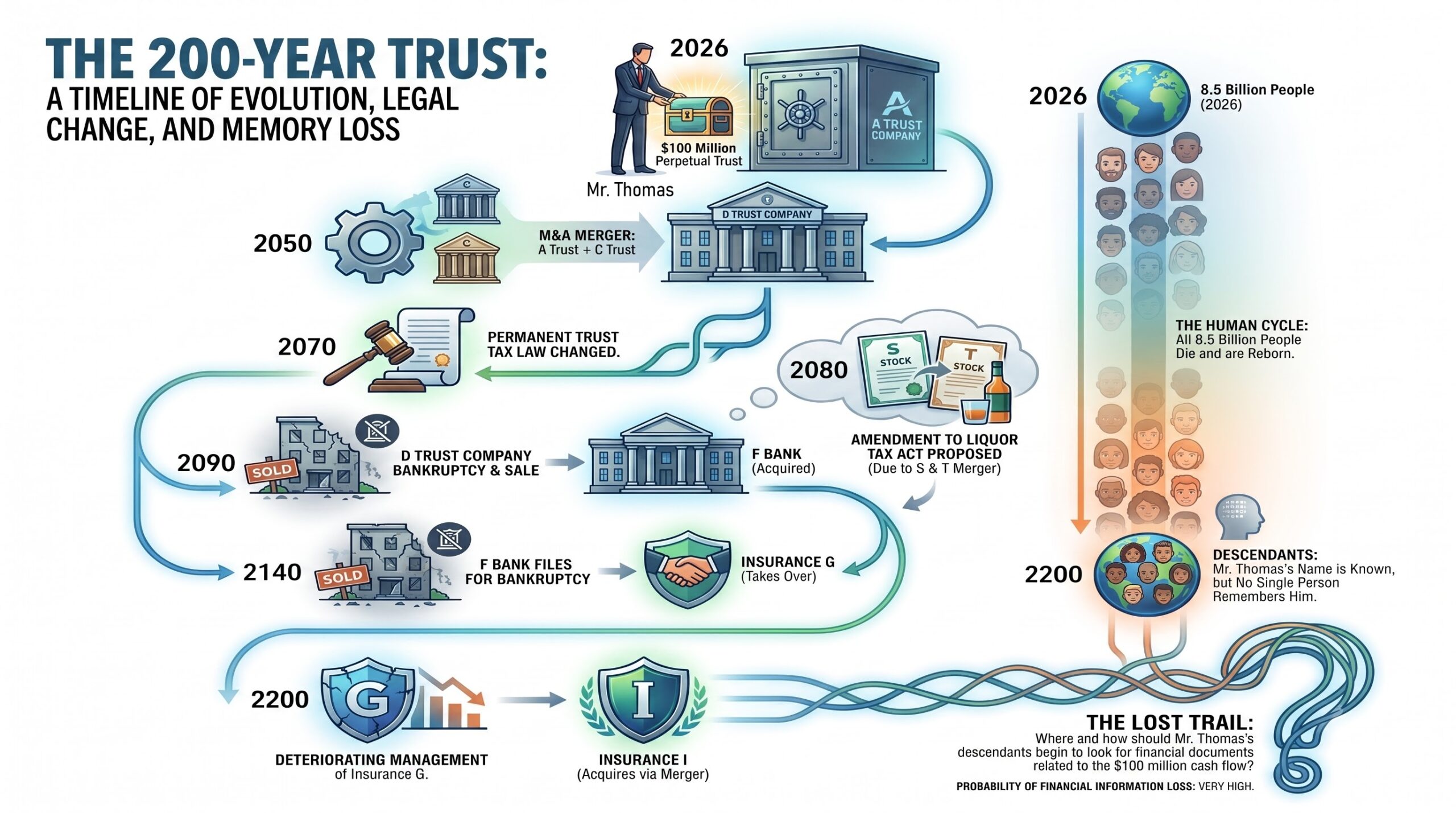
Consider a hypothetical client named Thomas who establishes a $100 million perpetual trust in 2026.
$100 Million Trust Established
Thomas establishes a perpetual trust with Trust Company A.
Merger & Rebranding
Trust Company A merges with Company C and becomes Trust Company D.
Tax Law Changes
New legislation changes the tax treatment and administration of perpetual trusts.
Institutional Failure
Trust Company D enters insolvency proceedings and its trust business is transferred to Bank F.
Another Successor
Bank F is reorganized and responsibility for the account passes to Financial Institution G.
Jurisdiction Changes
Political and regulatory changes modify the jurisdiction governing the trust.
Six or More Generations Later
The institution managing the assets may bear little resemblance to the organization Thomas originally contracted with.
THE QUESTION
In the year 2200, where does Thomas’ legal successor begin searching?
The original institution may no longer exist. Its name may have disappeared. Databases may have been replaced repeatedly. Several generations of employees and administrators may have come and gone.
The assets may survive. The challenge is preserving an independently traceable record of how they arrived there.
ASUKA · JAPAN
Continuity Measured in Centuries
The name ASUKA draws inspiration from Japan’s Asuka period, beginning in 592, and from the historic region of Asuka in present-day Nara Prefecture.
Japan provides extraordinary examples of organizations, businesses and professional traditions that have survived changes in government, ownership, technology and society over exceptionally long periods.
Beginning of the Asuka Period
JAPANESE LONGEVITY
More Than 1,000 Years of Institutional Heritage
ASUKA GROUP studies long-lived Japanese organizations as models for institutional succession, record continuity and intergenerational preservation.
| Organization | Traditional Founding | Heritage in 2026 | Field |
|---|---|---|---|
| Kongo Gumi | 578 | 1,448 years | Temple & Shrine Construction |
| Ikenobo | 587 | 1,439 years | Ikebana Tradition |
| Nishiyama Onsen Keiunkan | 705 | 1,321 years | Hot Spring Inn |
| Koman | 717 | 1,309 years | Traditional Inn |
| Hoshi | 718 | 1,308 years | Hot Spring Inn |
| Genda Shigyo | 771 | 1,255 years | Traditional Paper |
| Tanaka Iga Butsuguten | 885 | 1,141 years | Buddhist Religious Goods |
| Nakamura Shaji | 970 | 1,056 years | Temple & Shrine Construction |
| Ichimonjiya Wasuke | 1000 | 1,026 years | Traditional Confectionery |
“Founding year” describes historical business or institutional lineage and does not necessarily mean that the same modern legal corporation has existed continuously since that date.
THE ASUKA CONTINUITY LAYER
The Institution May Change. The Record Must Continue.
Identity Continuity
Preserve legally validated client identity and succession information across generations.
Asset History
Maintain a historical record of relevant asset and trust information from the original registration forward.
Institutional Succession
Record changes of trustee, custodian, trust company or other relevant institution.
Legal Successor Access
Provide validated historical records to authorized legal successors under applicable law and contract.
CONTRACT PROCESS
From Initial Registration to Future Succession
Client Consultation
Define the trust, preservation scope, jurisdictions and authorized parties.
Legal Record Registration
Legally validated personal and asset-related information is registered within the ASUKA GROUP preservation system.
Continuous Updates
Material changes to legally relevant identity, ownership or asset information are recorded.
Trustee Transition Support
When a trustee or financial institution changes, continuity records are updated to reflect the transition.
Long-Term Preservation
The most recent verified information remains connected to the historical record.
Future Legal Successor Access
If historical records are unavailable elsewhere, an authorized successor may request the preserved chain of identity and asset information, subject to applicable law and verification.
THINK BEYOND ONE GENERATION
Preserve the Record Beyond the Institution
Long-term trusts require more than asset management. They require a system designed to maintain continuity when institutions, technology and generations change.
Discuss Long-Term PreservationCONTACT ASUKA GROUP
Permanent Data Preservation Consultation
Contact ASUKA GROUP regarding long-term trust record preservation, institutional partnerships and continuity planning.
ASUKA GROUP
15F, Toranomon Hills Business Tower
1-17-1 Toranomon, Minato-ku
Tokyo 105-6415, Japan
Tel: +81-3-6807-3391
Fax: +81-3-6206-6949